| Lesson 2 | The TCP/IP protocol in Distributed Computing |
| Objective | Four Layers of the TCP/IP protocol |
Four Layers of the TCP/IP protocol
The traditional conceptual model for the TCP/IP protocol stack consists of four layers. However, depending on how it is presented, the model could potentially be dissected into more layers. These layers are generally as follows:
Although this four-layer model is widely used for illustrative purposes, in practice, the actual implementation of TCP/IP in modern systems tends to be more complex. There are subdivisions within these four layers, which could potentially be considered as additional separate layers, leading to models with five or even seven layers.
For instance, the Network Interface Layer can be further divided into the Data Link Layer and the Physical Layer, and the Application Layer can be broken down into the Application, Presentation, and Session Layers. These subdivisions align more closely with the seven-layer Open Systems Interconnection (OSI) model, which provides a more detailed perspective on network communication.
It's important to note that both the four-layer TCP/IP model and the seven-layer OSI model are simplifications. They are conceptual tools used to understand and explain complex network interactions rather than absolute truths about how network software and hardware must be designed. Real-world network protocols and systems often do not fit perfectly into one model or the other.
- Network Interface (or Link) Layer: This is the lowest layer and is responsible for the actual transmission of data across the network. Protocols at this layer provide the means to deliver data over a specific type of physical network such as Ethernet, Wi-Fi, or a point-to-point protocol over a modem connection.
- Internet Layer: This layer manages the movement of packets around the network. The key protocol at this layer is the Internet Protocol (IP), which defines IP addresses and routes packets. The Internet Control Message Protocol (ICMP), which provides feedback about network problems, also resides at this layer.
- Transport Layer: This layer is responsible for communication between processes, segmentation of data, flow control, and error recovery. TCP (Transmission Control Protocol) and UDP (User Datagram Protocol) are the primary protocols at this layer. TCP provides reliable, connection-oriented communication while UDP provides unreliable, connectionless communication.
- Application Layer: This is the highest layer of the stack and is the one closest to the user. Protocols at this layer provide specific functionality for applications. Examples include HTTP (for web browsing), SMTP (for email), and FTP (for file transfer).
Although this four-layer model is widely used for illustrative purposes, in practice, the actual implementation of TCP/IP in modern systems tends to be more complex. There are subdivisions within these four layers, which could potentially be considered as additional separate layers, leading to models with five or even seven layers.
For instance, the Network Interface Layer can be further divided into the Data Link Layer and the Physical Layer, and the Application Layer can be broken down into the Application, Presentation, and Session Layers. These subdivisions align more closely with the seven-layer Open Systems Interconnection (OSI) model, which provides a more detailed perspective on network communication.
It's important to note that both the four-layer TCP/IP model and the seven-layer OSI model are simplifications. They are conceptual tools used to understand and explain complex network interactions rather than absolute truths about how network software and hardware must be designed. Real-world network protocols and systems often do not fit perfectly into one model or the other.
Four layers of the TCP/IP Protocol
Question: What are the four layers of the TCP/IP protocol?
Because UNIX systems almost always operate in a networked environment, and because UNIX networking is synonymous with TCP/IP, a UNIX administrator must have a general understanding of the principles of TCP/IP networking. Therefore, we will begin our discussion of UNIX networking with some general remarks on TCP/IP. A network protocol, such as TCP/IP, is a systematic method of enabling processes on one computer to communicate with processes on other computers. To make this rather formidable task approachable, network engineers divide the overall problem into a set of subproblems. They devise systems to solve these subproblems, and then glue the solutions together to solve the overall problem. The buzz word for these subproblems is layers. Each layer in a networking protocol solves one stage of the overall problem of moving data between machines. The layers together form a protocol stack. TCP/IP divides the problem of moving data into four subproblems, so the TCP/IP protocol stack has four layers.
These layers are:
Because UNIX systems almost always operate in a networked environment, and because UNIX networking is synonymous with TCP/IP, a UNIX administrator must have a general understanding of the principles of TCP/IP networking. Therefore, we will begin our discussion of UNIX networking with some general remarks on TCP/IP. A network protocol, such as TCP/IP, is a systematic method of enabling processes on one computer to communicate with processes on other computers. To make this rather formidable task approachable, network engineers divide the overall problem into a set of subproblems. They devise systems to solve these subproblems, and then glue the solutions together to solve the overall problem. The buzz word for these subproblems is layers. Each layer in a networking protocol solves one stage of the overall problem of moving data between machines. The layers together form a protocol stack. TCP/IP divides the problem of moving data into four subproblems, so the TCP/IP protocol stack has four layers.
These layers are:
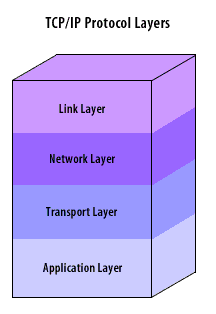
- An application-layer protocol is a language network clients and servers use to communicate with each other
- An application-layer protocol is a language network clients and servers use to communicate with each other.
- The network layer is responsible for moving data between machines across the boundaries of physical networks.
- The transport layer handles the problem of directing information between processes, rather than just between machines.
- The link layer is responsible for establishing communication between machines at the level of a physical connection.

