| Lesson 6 | Encrypting - Decrypting Data |
| Objective | Types and uses of encryption |
Types and uses of Encryption
Question: What are the types and uses of encryption?
Encryption is the process of converting plaintext information into a ciphertext, which is an unreadable format, using an algorithm and a secret key. The primary goal of encryption is to ensure the confidentiality, integrity, and authenticity of data by protecting it from unauthorized access, tampering, or disclosure. There are two main types of encryption, each with distinct uses and applications: symmetric encryption and asymmetric encryption.
Encryption is the process of converting plaintext information into a ciphertext, which is an unreadable format, using an algorithm and a secret key. The primary goal of encryption is to ensure the confidentiality, integrity, and authenticity of data by protecting it from unauthorized access, tampering, or disclosure. There are two main types of encryption, each with distinct uses and applications: symmetric encryption and asymmetric encryption.
1. Symmetric Encryption:
In symmetric encryption, the same secret key is used for both encryption and decryption processes. This type of encryption is typically faster and more efficient than asymmetric encryption, making it suitable for large-scale data encryption and secure communication.
Uses of symmetric encryption:
Uses of symmetric encryption:
- Data-at-rest encryption: Symmetric encryption is commonly used to protect sensitive data stored on devices, servers, or cloud storage systems. By encrypting data-at-rest, organizations can prevent unauthorized access and ensure data confidentiality.
- b. Data-in-transit encryption: Symmetric encryption is also used for protecting data transmitted between systems, such as during file transfers or communication between client and server applications. Examples include the use of symmetric encryption in secure communication protocols like TLS (Transport Layer Security) and SSL (Secure Sockets Layer).
- c. Secure key exchange: In some instances, symmetric encryption is used in combination with asymmetric encryption to securely exchange secret keys between parties for subsequent encrypted communication.
Common symmetric encryption algorithms include the Advanced Encryption Standard (AES), Triple Data Encryption Standard (3DES), and RC4.
2. Asymmetric Encryption:
Asymmetric encryption, also known as public-key encryption, uses two separate keys: a public key for encryption and a private key for decryption. The public key can be freely distributed, while the private key must be kept secret. Asymmetric encryption is generally slower and less efficient than symmetric encryption but offers distinct advantages in terms of security and key management.
Uses of asymmetric encryption:
Encryption plays a vital role in securing data and communication in various contexts. Symmetric encryption provides efficiency and speed for large-scale data encryption, while asymmetric encryption offers enhanced security and key management for secure communication and digital signatures. By understanding the types and uses of encryption, organizations and individuals can make informed decisions when implementing security measures to protect their data and communications.
Uses of asymmetric encryption:
- Secure communication: Asymmetric encryption is used to establish secure communication channels between parties without the need to exchange secret keys beforehand. Each party can encrypt messages using the recipient's public key, ensuring that only the recipient with the corresponding private key can decrypt the message.
- Digital signatures: Asymmetric encryption enables the creation of digital signatures, which provide data integrity, authenticity, and non-repudiation. A sender can sign a message using their private key, and the recipient can verify the signature using the sender's public key, ensuring the message's origin and integrity.
- Key exchange: Asymmetric encryption is often used in combination with symmetric encryption to securely exchange symmetric keys for data encryption. A widely used example is the Diffie-Hellman key exchange protocol.
Encryption plays a vital role in securing data and communication in various contexts. Symmetric encryption provides efficiency and speed for large-scale data encryption, while asymmetric encryption offers enhanced security and key management for secure communication and digital signatures. By understanding the types and uses of encryption, organizations and individuals can make informed decisions when implementing security measures to protect their data and communications.
Encrypting and decrypting data is nothing more than passing the data through an algorithm[1] to make something readable only to the intended recipients. The process for encryption is essentially identical to the process for decryption. At the document level, encryption takes an easily read plaintext[2] file and turns it into ciphertext[3] using a key[4] in conjunction with a specific algorithm. Encryption has become important not only in regard to e-mail, but also for network communications.
Encryption strength
Encryption strength is based on three primary factors:
- The first is strength of the algorithm
- The second factor is the secrecy of the key
- Length of the key
Strong encryption
The U.S. government classifies encryption that uses keys in excess of 40 bits as "strong encryption." U.S. companies wishing to export products that use strong encryption must first obtain State Department permission to do so.
Although 40-bit keys are not always strong enough for financial transactions, they are usually sufficient for individuals' needs.
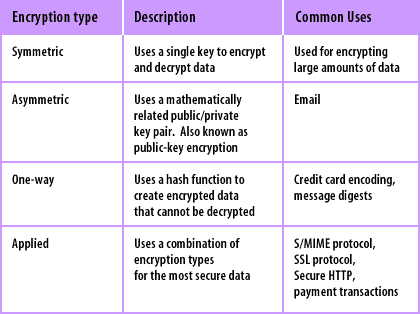
Encryption types
All types of encryption are subject to defeat. C View the Iimage below to see encryption types, descriptions and commonly used algorithms.
Encryption threats
Symmetric, or single-key, encryption is a simple process that is fast and strong. However, all parties must know and trust each other completely, and have confidential copies of the key.
Hackers can compromise symmetric keys either with a
dictionary program ,
password sniffing, or
by simply snooping through a desk, purse, or briefcase.
One countermeasure is to change your key regularly. This can reduce the danger of having a symmetric key compromised.
- Dictionary program: A program specifically written to break into a password-protected system. A dictionary program has a relatively large list of common password names that the program repeatedly uses to gain access .
- Password sniffing: Finding a way to intercept the transmission of a password during the authentication process. A sniffer is a program used to intercept passwords.
- Key: A method of opening an encryption. A key can be as simple as a string of text characters, or a series of hexadecimal digits.
Click the link to read about encryption terms and their descriptions.
Encryption Methods
Encryption Methods
[1]
Algorithm: A computable set of steps to achieve a desired result.
[2]
Plaintext: A message before encryption or after decryption, i.e. in its usual form which anyone can read, as opposed to its encrypted form, ciphertext.
[3]
Ciphertext: Text which has been encrypted by some encryption system.
[4]
Key: A method of opening an encryption. A key can be as simple as a string of text characters, or a series of hexadecimal digits.
